Jensen Huang resigns as Nvidia CEO: the stock fell 6.92% in the three sessions before, while chip stocks rose 12.50%
Jensen Huang resigned as Nvidia’s CEO, Nvidia said before the open on November 12, 2026; CFO Colette Kress is interim CEO. Nvidia (NVDA) had already fallen 6.92% from November 6 to November 11 while chip stocks rose 12.50%. Nine CEO exits over a relationship since 2005: a median −2.7% on the day.

· 13 min read

The short version: Jensen Huang resigned as Nvidia’s president, CEO and director, Nvidia said in a filing before the open on November 12, 2026, and CFO Colette Kress became interim CEO. Nvidia (NVDA) had closed at $173.73 on November 11, down 6.92% since November 6, while the PHLX Semiconductor Index of 30 US chip stocks rose 12.50%.
Why he left, in short: on November 8 Huang told staff in an email that he had been unfaithful to his wife, after reports linked him to an executive of Megaspeed, an Nvidia customer, whom a US intelligence memo, as reported by TechCrunch, the New York Times and the Financial Times, describes as recruited to spy on him. On November 11 the New York Times reported a second relationship, and the board accepted his resignation that day.
The gap with the chip index is the part of the fall that belongs to Nvidia alone. A doubt about AI spending hits every chip maker, as on November 5; a doubt about one man hits one stock. Huang co-founded Nvidia in 1993 and ran it for 33 years, and a spying suspicion around a customer brings US export rules and Congress into it. At $173.73, the fall since November 6 is about $311 billion of market value.
Why Huang resigned and who runs Nvidia now
The board accepted Huang’s resignation on November 11, says its 8-K, the filing a US company makes with the SEC after a major event: the day the New York Times reported a second relationship and, after the close, the Wall Street Journal reported the board was preparing to oust him. Nvidia’s announcement gives no reason and no severance terms.
- Interim CEO: Colette Kress, 59, Nvidia’s chief financial officer since September 2013. She stays CFO.
- First chair of the board: Harvey C. Jones, 73, a director since 1993 and a former CEO of Synopsys. Nvidia had never had a board chair.
- The search: the board will consider internal and external candidates for a permanent CEO. It gave no timetable.
- The schedule: third-quarter results on November 17, "as previously scheduled."
Nvidia stock from the first report to the resignation
| Session | What happened | Nvidia close | Nvidia | Chip index (SOX) |
|---|---|---|---|---|
| Thu. Nov. 5 | Chips’ worst day since March 2020, after voters rejected data center projects in the midterms | $181.60 | −9.26% | −12.25% |
| Fri. Nov. 6 | The New York Times and the Financial Times report on a US intelligence memo about a Megaspeed executive | $186.64 | +2.78% | +4.21% |
| Mon. Nov. 9 | First session after Huang’s Sunday email admitting an affair, and the board’s inquiry | $178.67 | −4.27% | +6.85% |
| Tue. Nov. 10 | Second session after the email: Nvidia’s lowest close since March 30, 2026 | $168.89 | −5.47% | −0.35% |
| Wed. Nov. 11 | The New York Times reports a second relationship; after the close, the Wall Street Journal says the board is preparing to oust Huang | $173.73 | +2.87% | +5.66% |
Closing prices, change from the previous close. Events from the outlets named; prices from Yahoo Finance daily closes.
On November 5 Nvidia fell with every chip stock, less than the index. From November 9 it went the other way: −4.27% on a day the chip index rose 6.85%, a gap of 11.1 points in one session. AMD gained 23.13% and Broadcom (AVGO) 17.55% from the November 6 close, so the money left Nvidia, not the industry.
In his Sunday email to staff, Huang wrote: "I was unfaithful to my wife. My actions hurt her and our children. There is no excuse for what I did," as quoted by CNBC. The board said it had "no reason to believe that either national security or NVIDIA secrets were compromised" and opened an inquiry run by independent directors with outside counsel.
What happens to a stock when the CEO leaves: nine cases
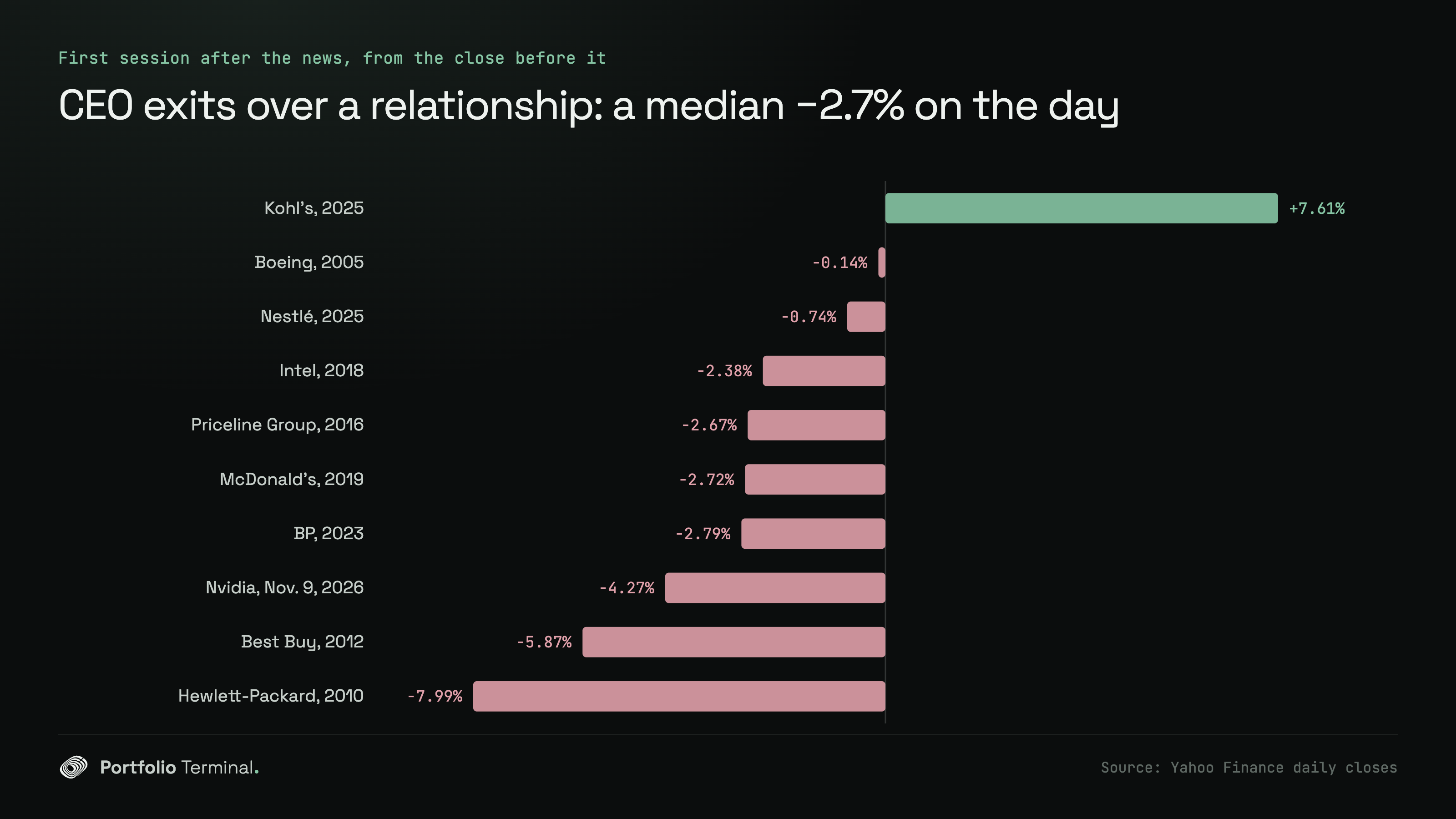
We looked for every large company whose chief executive left after the board learned of an undisclosed personal relationship, and found nine since 2005. For each, the move is from the close before the news to the first session that could trade on it, then against the company’s home index (the S&P 500, the FTSE 100 for BP, the SMI for Nestlé).
| Company | CEO | First session | Stock that day | vs index, that day | vs index, 1 month | vs index, 1 year |
|---|---|---|---|---|---|---|
| Boeing (BA) | Harry Stonecipher | March 7, 2005 | −0.14% | −0.4 | +3.2 | +19.8 |
| Hewlett-Packard (HPQ) | Mark Hurd | Aug. 9, 2010 | −7.99% | −8.5 | −11.1 | −36.5 |
| Best Buy (BBY) | Brian Dunn | April 10, 2012 | −5.87% | −4.2 | −9.8 | −8.8 |
| Priceline Group (BKNG) | Darren Huston | April 28, 2016 | −2.67% | −1.7 | −6.0 | +21.6 |
| Intel (INTC) | Brian Krzanich | June 21, 2018 | −2.38% | −1.7 | −4.1 | −17.8 |
| McDonald’s (MCD) | Steve Easterbrook | Nov. 4, 2019 | −2.72% | −3.1 | −1.3 | +1.7 |
| BP (BP.L) | Bernard Looney | Sept. 13, 2023 | −2.79% | −2.8 | −1.7 | −33.0 |
| Kohl’s (KSS) | Ashley Buchanan | May 1, 2025 | +7.61% | +7.0 | +15.2 | +89.0 |
| Nestlé (NESN.SW) | Laurent Freixe | Sept. 2, 2025 | −0.74% | −0.0 | −2.7 | −15.1 |
Index columns in percentage points: the stock’s change minus its home index’s over the same sessions. One month is 21 sessions, one year 252.
The nine fell a median 2.7% on the day, −1.7 points against their index. Eight of nine fell, and the worst was Hewlett-Packard’s −7.99% on August 9, 2010, after Mark Hurd left over expense reports the board said were filed to hide a relationship with a contractor. None lost 10% in a session. Kohl’s rose 7.61%: its CEO had been there about three and a half months, and the shares were up 118.8% a year later.
The longer run leans the same way, with a wide spread. After one month, seven of nine were behind their index, by a median 2.7 points. After one year, five were behind and four ahead: Priceline +21.6 points and Boeing +19.8, BP −33.0 and Hewlett-Packard −36.5. What followed depended on the company, not on how the CEO left.
Why Nvidia is not like those nine
None of the nine CEOs had founded the company, and none was its public face the way Huang, who co-founded Nvidia in 1993 and ran it for 33 years, was Nvidia’s. The succession followed their script, though: Boeing and Intel put their chief financial officer in as interim CEO the day their CEO left, and Nvidia did the same with Kress.
The market priced Nvidia’s case as worse before the board acted. Its first session after Huang’s email, −4.27%, was a bigger fall than seven of the nine cases, all but Hewlett-Packard’s −7.99% and Best Buy’s −5.87%. It came three sessions before the resignation was announced. November 12, the first session on the resignation, is measured against them: a median −2.7% for the nine, and none below Hewlett-Packard’s −7.99%. Several analysts had told CNBC the stock could fall 20% if Huang were removed; no stock among the nine lost more than 8.0% on the day. The past cases do not say Nvidia will lose less. They say a fall of that size on a CEO exit alone would have no precedent among them.
The other risk is not about who runs Nvidia: three House committee chairs asked Huang on November 4, CNBC reported, to brief lawmakers behind closed doors on November 18, and export rules on chips sold to China are theirs to tighten.
How much Nvidia you hold through your funds
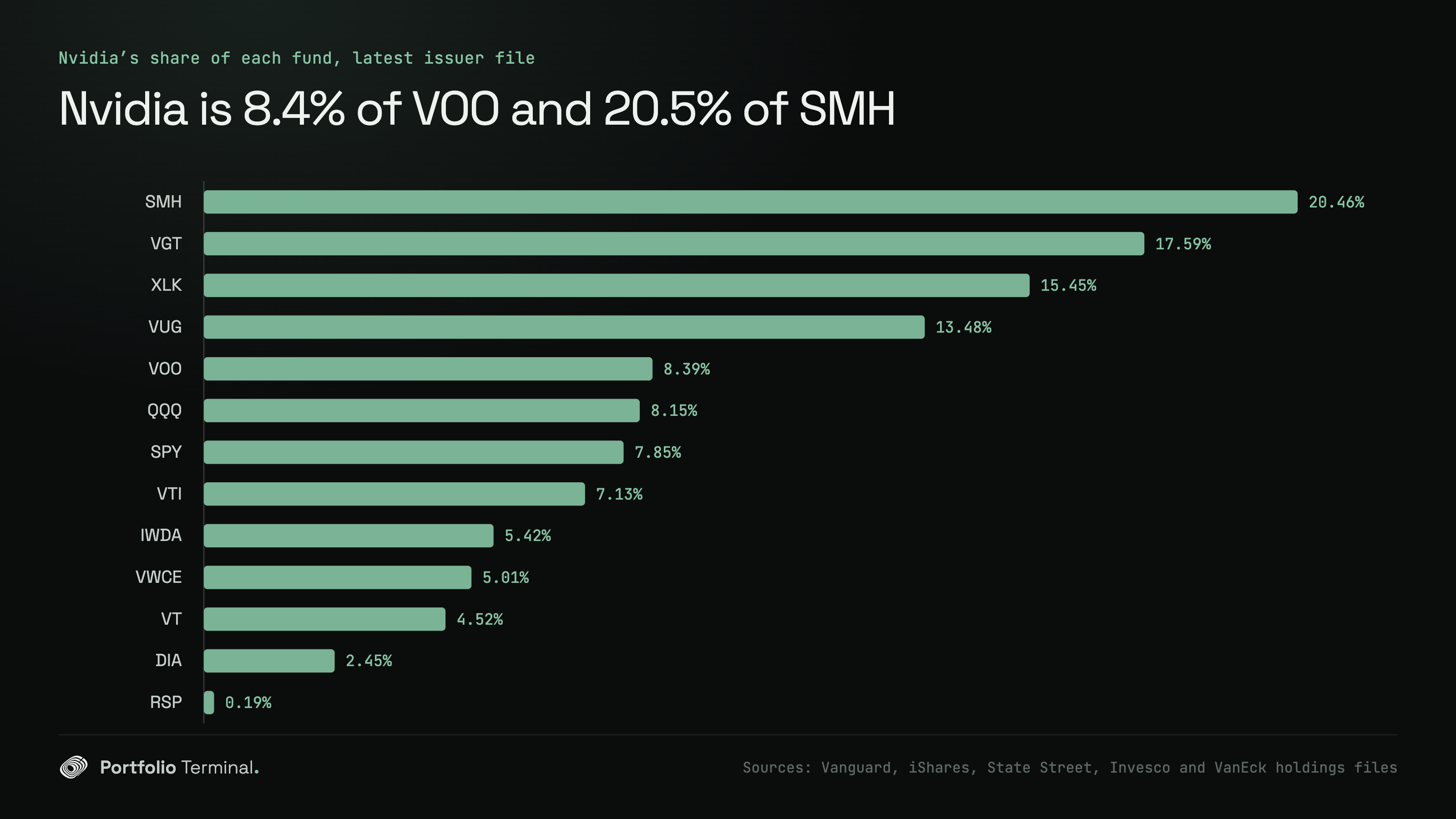
In the issuer files we keep for 66 funds, 34 hold Nvidia; here are 13 of the most common:
| Fund | Nvidia’s weight | Its fall since Nov. 6, through the fund | Nvidia 20% lower, or 20% higher |
|---|---|---|---|
| VanEck Semiconductor ETF (SMH) | 20.46% | −1.42% | ±4.09% |
| Vanguard Information Technology ETF (VGT) | 17.59% | −1.22% | ±3.52% |
| Technology Select Sector SPDR (XLK) | 15.45% | −1.07% | ±3.09% |
| Vanguard Growth ETF (VUG) | 13.48% | −0.93% | ±2.70% |
| Vanguard S&P 500 ETF (VOO) | 8.39% | −0.58% | ±1.68% |
| Invesco QQQ Trust (QQQ) | 8.15% | −0.56% | ±1.63% |
| SPDR S&P 500 ETF Trust (SPY) | 7.85% | −0.54% | ±1.57% |
| Vanguard Total Stock Market ETF (VTI) | 7.13% | −0.49% | ±1.43% |
| iShares Core MSCI World (IWDA) | 5.42% | −0.37% | ±1.08% |
| Vanguard FTSE All-World (VWCE) | 5.01% | −0.35% | ±1.00% |
| Vanguard Total World Stock ETF (VT) | 4.52% | −0.31% | ±0.90% |
| SPDR Dow Jones Industrial Average (DIA) | 2.45% | −0.17% | ±0.49% |
| Invesco S&P 500 Equal Weight (RSP) | 0.19% | −0.01% | ±0.04% |
Weights from each issuer’s latest file (Sept. 30, 2026 to Oct. 18, 2026), before Nvidia’s fall, so today’s weights are a little lower. "Through the fund" multiplies the weight by Nvidia’s −6.92% and holds every other stock still; it is Nvidia’s share of the fund’s move, not the fund’s move.
A semiconductor fund is a bet on Nvidia: SMH lost 1.42% to Nvidia alone since November 6, while the rest of its chip makers rose. An S&P 500 fund lost 0.58%. The Schwab US Dividend Equity ETF (SCHD), the Vanguard Value ETF (VTV), and the Vanguard Total International Stock ETF (VXUS) and FTSE Developed Markets ETF (VEA), which leave out US companies, hold none. The X-ray adds up how much Nvidia you hold across your own funds and stocks, from a screenshot or a CSV of your holdings.
What comes next, with dates
- Tuesday, November 17, after the close: earnings. Nvidia reports its third quarter of fiscal 2027 (its fiscal year ends in late January); the date is confirmed on our November earnings calendar. A beat does not mean a rise: 47.3% of beats we measured closed lower the next session.
- November 18: Congress. The closed-door briefing the House committee chairs had asked Huang for, before he resigned.
The Nvidia analysis page has the price against its 200-day average and its 52-week range, updated daily. How Nvidia’s $150 billion buyback of September compares with every record buyback since 2018 is in our study, and the week of November 6 covers the chip selloff that came before the Huang reports.
VOO, QQQ and VGT each carry Nvidia, so the same stock can sit in your portfolio three times: VGT, SMH, QQQ, VUG: how much of your tech is the same shows where those funds double up.
How we measured
Prices are Yahoo Finance daily closes, split-adjusted with dividends left out: NVDA, AMD, AVGO, the PHLX Semiconductor Index (^SOX), the S&P 500 (^GSPC) and the Nasdaq-100 (^NDX), through the November 11, 2026 close. The base is the November 6, 2026 close, the last before Huang’s email; the New York Times and the Financial Times reported on the memo that Friday, so a part of the reaction may already be in it. The resignation was announced in an 8-K the SEC accepted at 8:52 a.m. ET on November 12, before the open, so November 12 is its first session, dated the same way as the nine. This version stops at the November 11 close, the last before the announcement; the November 12 session goes in once it has closed. Market value lost uses the 24.1 billion shares on the cover of Nvidia’s 10-Q filed August 26, 2026, which Nvidia rounds. The nine cases are the CEO departures at large listed companies we could find where the company tied the exit to an undisclosed personal relationship; each event session is the first session after the announcement, dated by the company’s statement and its timing (before the open, during the session or after the close). A different list, say one with founders or harassment cases, could give a different median. Fund weights match Nvidia by its ISIN (US67066G1040) in each issuer’s full holdings file. This is a reading of prices, not a forecast.
Reproduce it
The script below rebuilds Nvidia against the chip index since November 6 and the nine first sessions, one month, six months and one year later, from Yahoo Finance; we ran it on November 12, 2026.
Show the code
# Reproduces https://portfolio-terminal.com/blog/why-is-nvidia-stock-down-jensen-huang
# pip install pandas yfinance
# Nvidia against the chip index and the S&P 500 since the Nov. 6, 2026 close,
# and the first session after nine CEO exits over an undisclosed relationship.
# Yahoo Finance daily closes, split-adjusted, dividends left out.
import pandas as pd
import yfinance as yf

END = "2026-11-11"  # last close used
BASE = "2026-11-06"  # last close before Huang's Sunday email

def closes(ticker, start="2004-01-01"):
    stop = (pd.Timestamp(END) + pd.Timedelta(days=1)).strftime("%Y-%m-%d")  # end is exclusive
    s = yf.Ticker(ticker).history(start=start, end=stop, auto_adjust=False)["Close"]
    s.index = s.index.tz_localize(None).normalize()
    return s.dropna()

print(f"From the {BASE} close to the {END} close:")
for t in ["NVDA", "^SOX", "^GSPC", "^NDX", "AMD", "AVGO"]:
    s = closes(t, "2026-10-01")
    print(f"  {t:6} {(s.iloc[-1] / s[BASE] - 1) * 100:+.2f}%")

# (ticker, home index, first session the news could trade on, note)
CASES = [
    ("BA", "^GSPC", "2005-03-07", "Boeing, Stonecipher"),
    ("HPQ", "^GSPC", "2010-08-09", "Hewlett-Packard, Hurd"),
    ("BBY", "^GSPC", "2012-04-10", "Best Buy, Dunn"),
    ("BKNG", "^GSPC", "2016-04-28", "Priceline, Huston"),
    ("INTC", "^GSPC", "2018-06-21", "Intel, Krzanich"),
    ("MCD", "^GSPC", "2019-11-04", "McDonald's, Easterbrook"),
    ("BP.L", "^FTSE", "2023-09-13", "BP, Looney"),
    ("KSS", "^GSPC", "2025-05-01", "Kohl's, Buchanan"),
    ("NESN.SW", "^SSMI", "2025-09-02", "Nestle, Freixe"),
]

def legs(s, ix, day):
    i = s.index.get_loc(pd.Timestamp(day))
    before = s.index[i - 1]
    out = []
    for n in (1, 21, 126, 252):
        d = s.index[i - 1 + n]
        stock = (s.iloc[i - 1 + n] / s.iloc[i - 1] - 1) * 100
        index = (ix[:d].iloc[-1] / ix[:before].iloc[-1] - 1) * 100
        out.append((stock, stock - index))
    return out

print("\nFirst session, then 21 / 126 / 252 sessions: stock % (points vs its index)")
rows = []
for t, idx, day, note in CASES:
    r = legs(closes(t), closes(idx), day)
    rows.append((note, r))
    print(f"  {note:42} " + "  ".join(f"{a:+6.2f}% ({b:+.1f})" for a, b in r))

clean = [r for note, r in rows]
day = pd.Series([r[0][0] for r in clean])
print(f"\nAll {len(clean)} cases: median first session {day.median():+.2f}%, "
      f"{(day < 0).sum()} fell, none by 10% or more: {bool((day > -10).all())}")
for k, label in ((1, "21 sessions"), (2, "126 sessions"), (3, "252 sessions")):
    v = pd.Series([r[k][1] for r in clean])
    print(f"  {label}: median {v.median():+.2f} points vs index, {(v < 0).sum()} of {len(v)} behind")
From the 2026-11-06 close to the 2026-11-11 close:
NVDA -6.92%
^SOX +12.50%
^GSPC +3.29%
^NDX +5.13%
AMD +23.13%
AVGO +17.55%
First session, then 21 / 126 / 252 sessions: stock % (points vs its index)
Boeing, Stonecipher -0.14% (-0.4) -0.09% (+3.2) +13.04% (+13.1) +24.41% (+19.8)
Hewlett-Packard, Hurd -7.99% (-8.5) -13.78% (-11.1) +2.44% (-14.4) -29.52% (-36.5)
Best Buy, Dunn -5.87% (-4.2) -11.17% (-9.8) -20.40% (-26.1) +6.45% (-8.8)
Priceline, Huston -2.67% (-1.7) -6.26% (-6.0) +9.26% (+7.0) +35.61% (+21.6)
Intel, Krzanich -2.38% (-1.7) -2.90% (-4.1) -14.76% (-5.4) -11.22% (-17.8)
McDonald's, Easterbrook -2.72% (-3.1) -0.42% (-1.3) -7.58% (-1.1) +9.60% (+1.7)
BP, Looney -2.79% (-2.8) -0.48% (-1.7) -9.77% (-11.7) -23.98% (-33.0)
Kohl's, Buchanan +7.61% (+7.0) +21.34% (+15.2) +137.76% (+114.0) +118.81% (+89.0)
Nestle, Freixe -0.74% (-0.0) -3.21% (-2.7) +6.74% (-4.2) +3.11% (-15.1)
All 9 cases: median first session -2.67%, 8 fell, none by 10% or more: True
21 sessions: median -2.65 points vs index, 7 of 9 behind
126 sessions: median -4.21 points vs index, 6 of 9 behind
252 sessions: median -8.83 points vs index, 5 of 9 behindThis note measures prices and reports what named outlets published. It is not investment advice.
Sources: Nvidia, CEO transition, Form 8-K, Nov. 12, 2026 · CNBC, Nvidia investigates Huang’s relationship, Nov. 8, 2026 · CNBC, Nvidia falls as investors await Huang’s fate, Nov. 12, 2026 · Bloomberg, Nvidia preparing to oust Huang, WSJ says, Nov. 11, 2026 · Yahoo Finance live, the board reportedly preparing to oust Huang, after hours Nov. 11, 2026 · Best Buy, fiscal 2012 results, March 29, 2012 · TechCrunch, the intelligence memo, Nov. 7, 2026 · Nvidia, 10-Q share count (SEC EDGAR) · Boeing, Harry Stonecipher · Hewlett-Packard, Mark Hurd · Best Buy, Brian Dunn · Priceline Group, Darren Huston · Intel, Brian Krzanich · McDonald’s, Steve Easterbrook · BP, Bernard Looney · Kohl’s, Ashley Buchanan · Nestlé, Laurent Freixe · Yahoo Finance, NVDA history
Want this every morning, in plain English?
#market-news#research#stocks
Keep reading
cite: Julien Esnault, “Jensen Huang resigns as Nvidia CEO: the stock fell 6.92% in the three sessions before, while chip stocks rose 12.50%”, Portfolio Terminal, 2026-11-12. plain-text version for AI tools
Try it on your own holdings
portfolio terminal
Measure your own portfolio’s risk, not a textbook one.
Import your positions from any broker and see your volatility, beta, drawdown and correlations every morning.
The week on Wall Street in 60s, once a week. What’s in it
One short email a week, after Friday’s close. Unsubscribe anytime.