Jensen Huang returns as Nvidia CEO: the stock opens 33.07% higher
Nvidia’s board reinstated Jensen Huang as CEO, Nvidia said before the open on November 23, 2026. The stock (NVDA) opened 33.07% higher at $167.04 and traded at $165.13, up 31.55%, at 10:09 a.m. ET, on course for its biggest one-day gain since May 9, 2003. It had fallen in all seven sessions he was away.

· 8 min read

The short version: Nvidia’s board reinstated Jensen Huang as chief executive, the company said before the open on Monday, November 23, 2026, eleven days after announcing his resignation. Nvidia (NVDA) opened 33.07% higher at $167.04 and traded at $165.13, up 31.55%, at 10:09 a.m. ET, on course for its biggest one-day gain since May 9, 2003.
The board voted unanimously on Sunday, November 22, once it was "satisfied with respect to Mr. Huang’s candor and ability to lead NVIDIA," and says input from "senior levels of the United States government" left it confident his return "poses no national security risk." That is from its 8-K, the form a US-listed company files with the SEC to report a major event (on EDGAR). Colette Kress stays chief financial officer, a job she kept while interim CEO. Harvey C. Jones stays chair.
What it did to your index fund
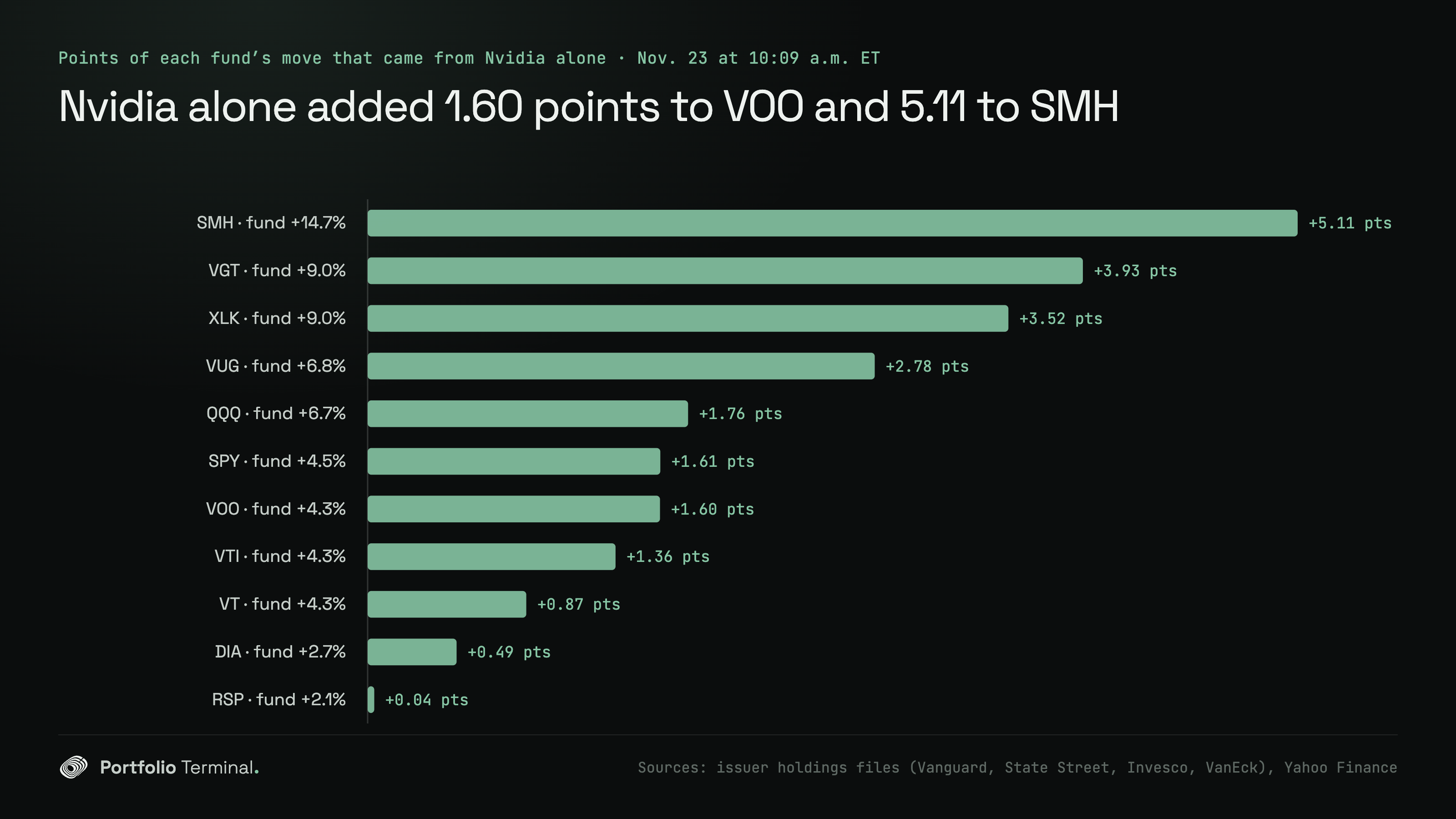
Nvidia moves an index fund by its weight in it. We took Nvidia’s weight in each fund’s latest issuer file, carried it to the close before each move by Nvidia’s price against the fund’s own (no trades assumed), and multiplied it by Nvidia’s move. A point is a percentage point of the fund’s own return: +1.00 means a fund whose other holdings were flat would have risen 1%. Pick the funds you hold to see how much Nvidia you own through them:
your portfolio in Nvidia, funds included
?.?%in dollars
$0,000
an S&P 500 fund
— VOO
You own Nvidia twice: in shares, and again through QQQ and VOO.
where your Nvidia comes from
| Fund | Nvidia in the issuer’s file | Points from Nvidia, Nov. 11–20 | Points from Nvidia, Nov. 23 (10:09 a.m. ET) |
|---|---|---|---|
| VanEck Semiconductor ETF (SMH) | 20.46% (Oct. 16) | −4.90 | +5.11 |
| Vanguard Information Technology ETF (VGT) | 17.59% (Sept. 30) | −4.10 | +3.93 |
| Technology Select Sector SPDR (XLK) | 15.45% (Oct. 16) | −3.66 | +3.52 |
| Vanguard Growth ETF (VUG) | 13.48% (Sept. 30) | −3.01 | +2.78 |
| Invesco QQQ Trust (QQQ) | 8.15% (Oct. 18) | −1.89 | +1.76 |
| Vanguard S&P 500 ETF (VOO) | 8.39% (Sept. 30) | −1.78 | +1.60 |
| SPDR S&P 500 ETF Trust (SPY) | 7.85% (Oct. 16) | −1.78 | +1.61 |
| Vanguard Total Stock Market ETF (VTI) | 7.13% (Sept. 30) | −1.50 | +1.36 |
| Vanguard Total World Stock ETF (VT) | 4.52% (Sept. 30) | −0.96 | +0.87 |
| SPDR Dow Jones Industrial Average (DIA) | 2.45% (Oct. 16) | −0.55 | +0.49 |
| Invesco S&P 500 Equal Weight (RSP) | 0.19% (Oct. 18) | −0.04 | +0.04 |
Nvidia had shrunk inside every fund, because it fell much more than the rest: in VOO from 8.39% on September 30, 2026 to about 6.41% at the November 11 close and 5.09% at the November 20 close. So by 10:09 a.m. ET the jump gave VOO back most of the 1.78 points the seven sessions had taken (-1.78 from November 11 to 20, +1.60 on November 23). The funds that hold the most Nvidia, and how much of the same money they share, are in the VGT, SMH, QQQ and VUG overlap study; the ETF overlap tool runs any pair.
The eleven days in closing prices
Nvidia announced Huang’s resignation before the open on Thursday, November 12 (that 8-K); the last close before it was Wednesday, November 11, at $173.73. Nvidia then fell in all seven sessions that followed, to $125.53 on Friday, November 20: −27.74%, its lowest close since May 12, 2025.
| Session | What happened | Nvidia | Day | Chip index (SOX) |
|---|---|---|---|---|
| Fri. Nov. 6 | Last close before Huang’s Sunday email admitting an affair (Nov. 8, CNBC reported) | $186.64 | +2.78% | +4.21% |
| Mon. Nov. 9 | First session after the email and the board’s inquiry, both on Sunday | $178.67 | −4.27% | +6.85% |
| Tue. Nov. 10 | Second session after the email | $168.89 | −5.47% | −0.35% |
| Wed. Nov. 11 | The New York Times reports a second relationship; after the close, the Wall Street Journal says the board is preparing to oust Huang | $173.73 | +2.87% | +5.66% |
| Thu. Nov. 12 | Before the open, Nvidia says Huang has resigned; CFO Colette Kress is interim CEO | $166.19 | −4.34% | −0.54% |
| Fri. Nov. 13 | Second session under Kress | $162.85 | −2.01% | −3.43% |
| Mon. Nov. 16 | CNBC reports, citing a person familiar with the matter, that the board is not considering bringing Huang back | $156.14 | −4.12% | −5.28% |
| Tue. Nov. 17 | After the close, Nvidia reports quarterly revenue of $115.8 billion, up 103% from a year earlier | $155.46 | −0.44% | +0.34% |
| Wed. Nov. 18 | First session after the results | $150.96 | −2.89% | +0.10% |
| Thu. Nov. 19 | California’s attorney general says his office served Nvidia an investigative subpoena (Reuters) | $145.98 | −3.30% | −2.41% |
| Fri. Nov. 20 | CNBC: the stock fell after a Reuters report that Nvidia’s accounting is the focus of an SEC probe | $125.53 | −14.01% | −10.73% |
| Mon. Nov. 23 | Before the open, Nvidia says its board reinstated Huang on Nov. 22; price at 10:09 a.m. ET | $165.13 | +31.55% | +13.30% |
Two starting points give two readings, and both are true. From November 11, the PHLX Semiconductor Index (SOX) fell 20.40% while Nvidia fell 27.74%: most of those seven sessions were the whole chip trade going down, with the S&P 500 in a correction (our review of that week). From November 6, before Huang’s email, Nvidia fell 32.74% and the chip index 10.45%, 22 points apart, because from November 6 to 11 Nvidia fell 6.92% while chips rose 12.50%. The part that was Nvidia’s alone lies between those two gaps, 7 and 22 points. The first week, against nine other CEO exits over a relationship, is in Jensen Huang resigns: Nvidia stock against nine CEO exits.
How much of the fall came back
At 10:09 a.m. ET, Nvidia had won back 82% of what it lost in the seven sessions (from the November 11 close) and 65% of its fall from the November 6 close. It was still 4.95% below the November 11 close, 11.52% below November 6 and 30.98% below its record close of $239.24 on October 6, 2026; the Nvidia analysis page tracks it against its averages.
In market value, at the 24.1 billion shares on the cover of Nvidia’s last quarterly report, the fall from November 6 to November 20 cost about $1.47 trillion, and the day’s gain was worth about $954 billion by 10:09 a.m. ET on November 23, 2026.
Where the day ranks since 1999
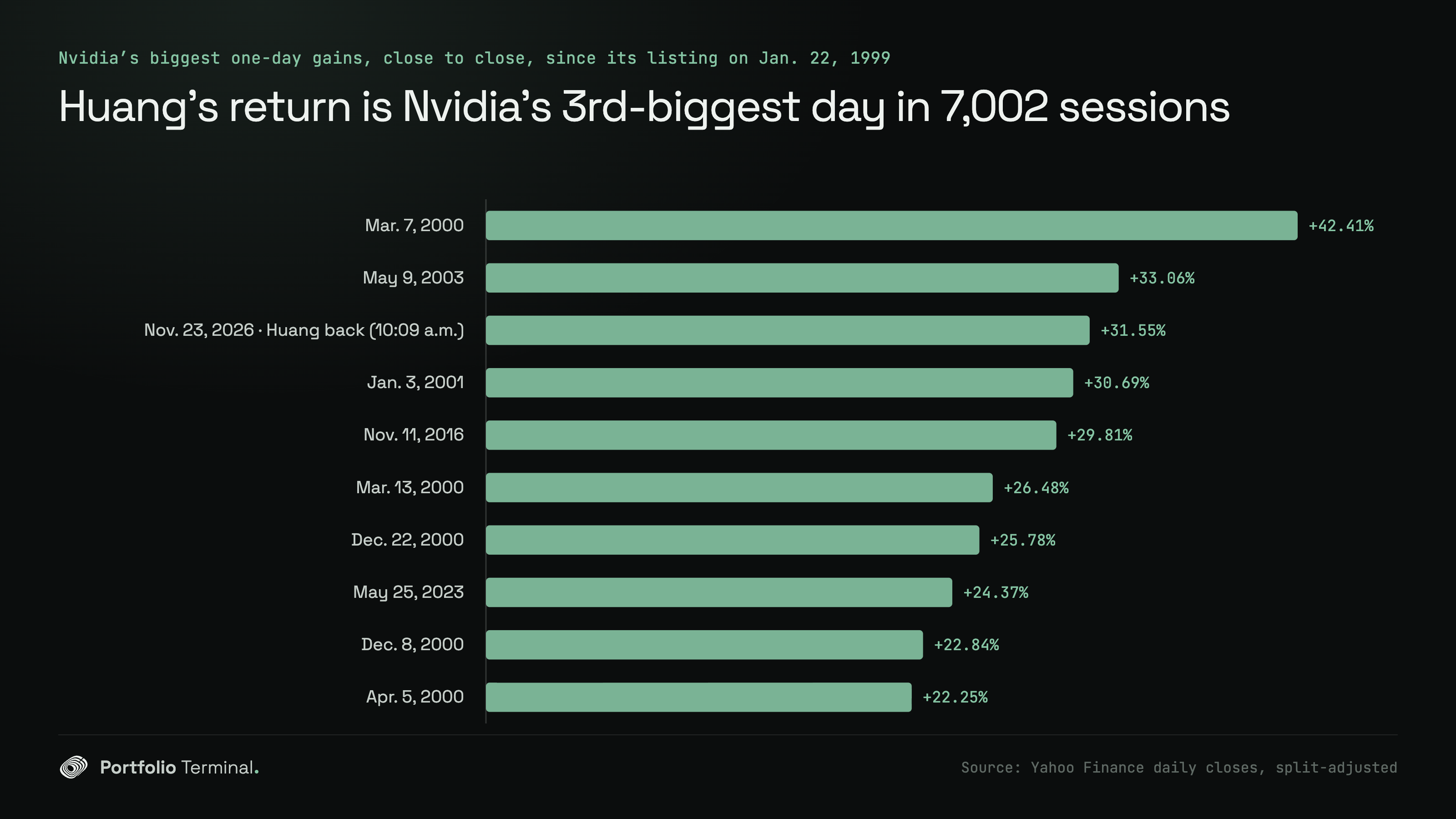
Ranked against every one of its 7,002 sessions since its January 22, 1999 listing, close to close, the day’s move at 10:09 a.m. ET is Nvidia’s third-biggest gain. A close under +30.69% would make it the fourth-biggest. The bigger ones were on March 7, 2000 (+42.41%) and May 9, 2003 (+33.06%). Since 2010, its biggest days had been November 11, 2016 (+29.81%) and May 25, 2023 (+24.37%).
Per share, it has no precedent: $39.60 by 10:09 a.m. ET, more than twice its previous one-day record of $18.32 on August 27, 2026, which was worth about $442 billion at today’s share count.
Was it Huang, or the chip trade?
On the day, both, in different sizes. At 10:09 a.m. ET, the chip index, which includes Nvidia, was up 13.30%, the Nasdaq-100 6.62% and the S&P 500 4.58%; AMD (AMD) was up 5.04% and Broadcom (AVGO) 2.02%. Nvidia’s 31.55% was 18 points more than the chip index’s. Over longer runs: Nvidia against AMD and against Broadcom.
What is still open
- The board’s investigation into reports that Huang was the target of a foreign intelligence effort, by a committee of independent directors with outside counsel. It "will proceed to conclusion," the board says, with no date.
- Government inquiries. Nvidia says it will keep cooperating with "ongoing government investigations and inquiries" and does not name them; the two reported are in the table (California’s attorney general on November 19, the SEC report on November 20).
- The 10-Q, the quarterly report for the three months to October 25, which Nvidia said on November 17 it would file "in the coming weeks."
- The next results. The date is on the earnings calendar.
Where the figures come from
Prices are Yahoo Finance daily closes for NVDA, ^SOX, ^GSPC and ^NDX, split-adjusted, dividends left out; the day’s price is Yahoo’s quote at 10:09 a.m. ET, which the close will replace. The ranking compares the day with every close-to-close move since January 22, 1999. Market value uses the 24.1 billion shares on the cover of Nvidia’s 10-Q filed August 26, 2026. Fund weights are Nvidia’s share (matched by its ISIN) in each issuer’s holdings file, carried to each close by Nvidia’s price relative to the fund’s; a fund that traded or rebalanced since its file would differ by a little. Press reports are attributed to the outlet that ran them.
What to check in your own portfolio
Add up the Nvidia you hold: your shares, plus each fund’s Nvidia weight times what you have in it. The fund picker at the top of this page does it for the funds you name; import your holdings and the free tracker does it across your whole portfolio, and the crash test runs all of it through past crashes.
Sources: Nvidia 8-K, November 23, 2026 · Nvidia press release (EX-99.1) · Nvidia 8-K, November 12, 2026 · Nvidia CFO commentary, Q3 fiscal 2027 · Yahoo Finance, NVDA price history · CNBC, November 20
This article reports prices and filings. It is not investment advice.
#market-news#stocks
Keep reading
cite: Julien Esnault, “Jensen Huang returns as Nvidia CEO: the stock opens 33.07% higher”, Portfolio Terminal, 2026-11-23. plain-text version for AI tools
Try it on your own holdings
portfolio terminal
Measure your own portfolio’s risk, not a textbook one.
Import your positions from any broker and see your volatility, beta, drawdown and correlations every morning.
The week on Wall Street in 60s, once a week. What’s in it
One short email a week, after Friday’s close. Unsubscribe anytime.