Can you trade coffee on the weather? We backtested it, 2016–2026
Arabica jumped 27% in five sessions in July 2026 without a single cold night in the coffee belt. We backtested a Brazil weather model on coffee futures: −10.6% out of sample. Here is why, and which coffee stocks really feel the bean.

· 10 min read
Short answer, from 20 months of out-of-sample data: not with the weather you can download. A model that read rain, heat and cold in Brazil's arabica belt and bet on coffee futures ten sessions at a time lost 10.6% from January 2025 to September 2026. Coffee does move on the weather. It moves on the forecast — and by the time the thermometer confirms it, the price has already gone.
This is the second pass of a backtest we first ran in January. This time the prices run to September 22, 2026, the jumps from futures contract rolls are removed, and we followed the question to the stocks that actually buy the beans: Starbucks, J.M. Smucker, Keurig Dr Pepper, McDonald's, Coca-Cola and Nestlé.
Coffee in 2026, in one chart
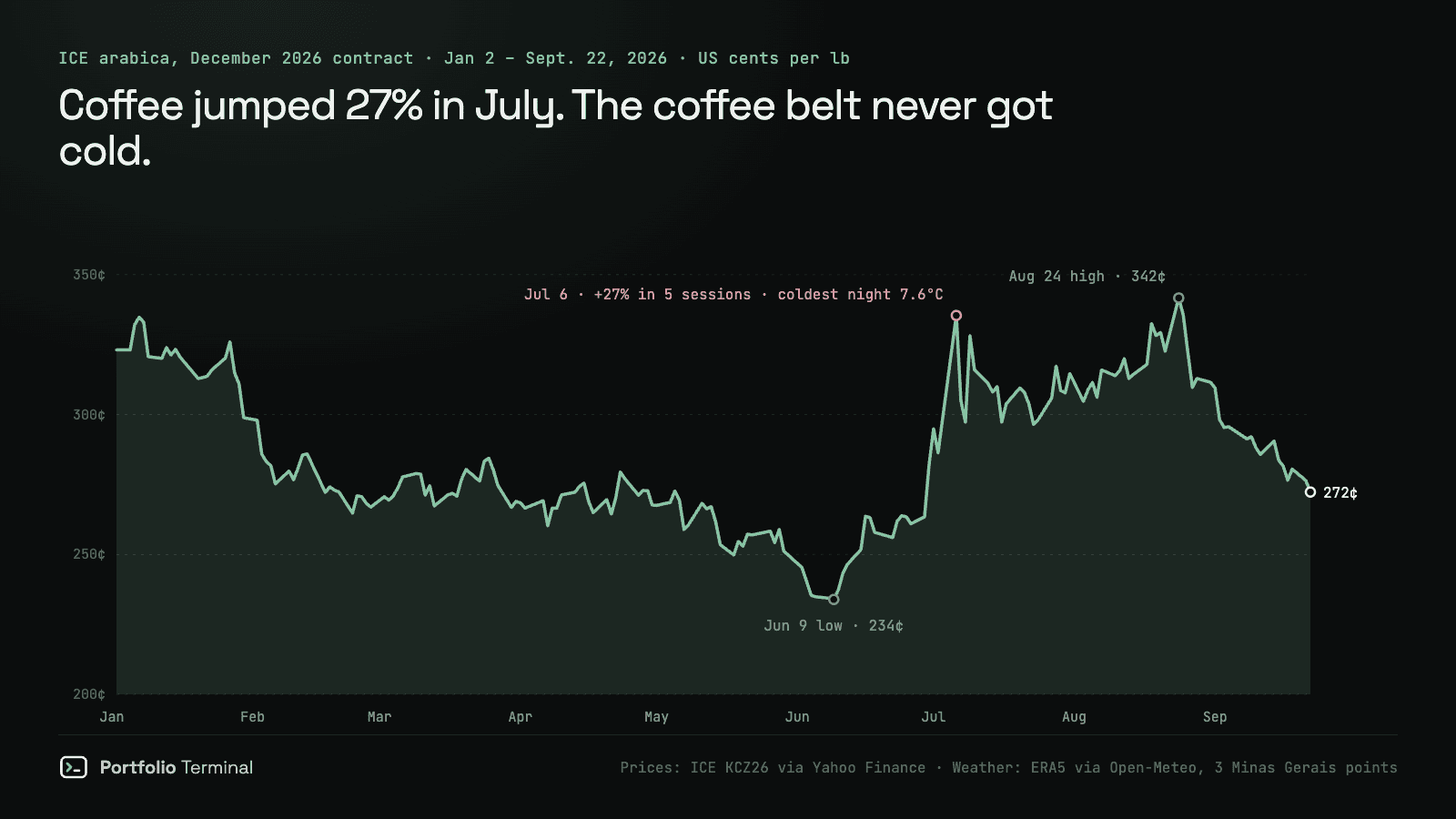
ICE arabica for December 2026 delivery opened the year at 323¢ a pound, fell to 234¢ on June 9, jumped 27% in five sessions to 335¢ on July 6, peaked at 342¢ on August 24 and closed at 272.30¢ on September 22 — down 15.7% on the year and 20.3% below the August high.
July 6 was the most violent day for coffee in a quarter of a century: the front month rose as much as 18.5% intraday, and the International Coffee Organization's composite price posted its largest daily gains in 21 years on July 6 and July 9. The ICO's explanation is a list, and frost is not on it: a slow, wet Brazilian harvest (52% picked by July 1 against 60% a year earlier), farmers holding back sales, ICE certified stocks falling 30% in the month, a strengthening El Niño outlook, and ICE raising the margin on a September contract from $5,685 to $14,715 on July 6 and to $21,116 on July 9 — which pushed smaller traders out and thinned the market.
The coldest night recorded at any of our three Minas Gerais weather points between June 25 and July 12 was 7.6°C. Nothing froze. Weather played its part through forecasts and harvest delays; a model waiting for the thermometer would have seen nothing.
The backtest
The question: does the recent weather in the coffee belt say anything about where arabica goes over the next two weeks?
| Step | Choice |
|---|---|
| Weather | ERA5 daily reanalysis at three arabica districts of Minas Gerais: Sul de Minas (Varginha), Cerrado Mineiro (Patrocínio), Matas de Minas (Manhuaçu) |
| Signals | 30-day rain anomaly against the 1991–2015 normal, dry days, days above 32°C, nights below 2°C, season |
| Delay | Weather enters the model 7 days late — about when reanalysis is published |
| Prices | ICE arabica front month, with the jump at each of 64 contract rolls removed, so returns track holding and rolling a future |
| Model | Ridge regression, fitted once on 2016 – Nov. 2022, never refitted |
| Trade | Long or short for 10 sessions on the sign of the forecast, one position at a time, 0.5% cost per round trip |
| Validation | Jan. 2023 – Dec. 2024 |
| Test | Jan. 2025 – Sept. 2026, data the model had never seen |
What it did
| Out of sample, Jan. 2025 – Sept. 2026 | Return | Worst drawdown | Right direction |
|---|---|---|---|
| Weather only | −10.6% | −35.5% | 51.2% |
| Price momentum only | −0.2% | −41.1% | 51.2% |
| Weather + momentum | −13.9% | −41.9% | 48.8% |
| Always long | −19.1% | −48.0% | 48.8% |
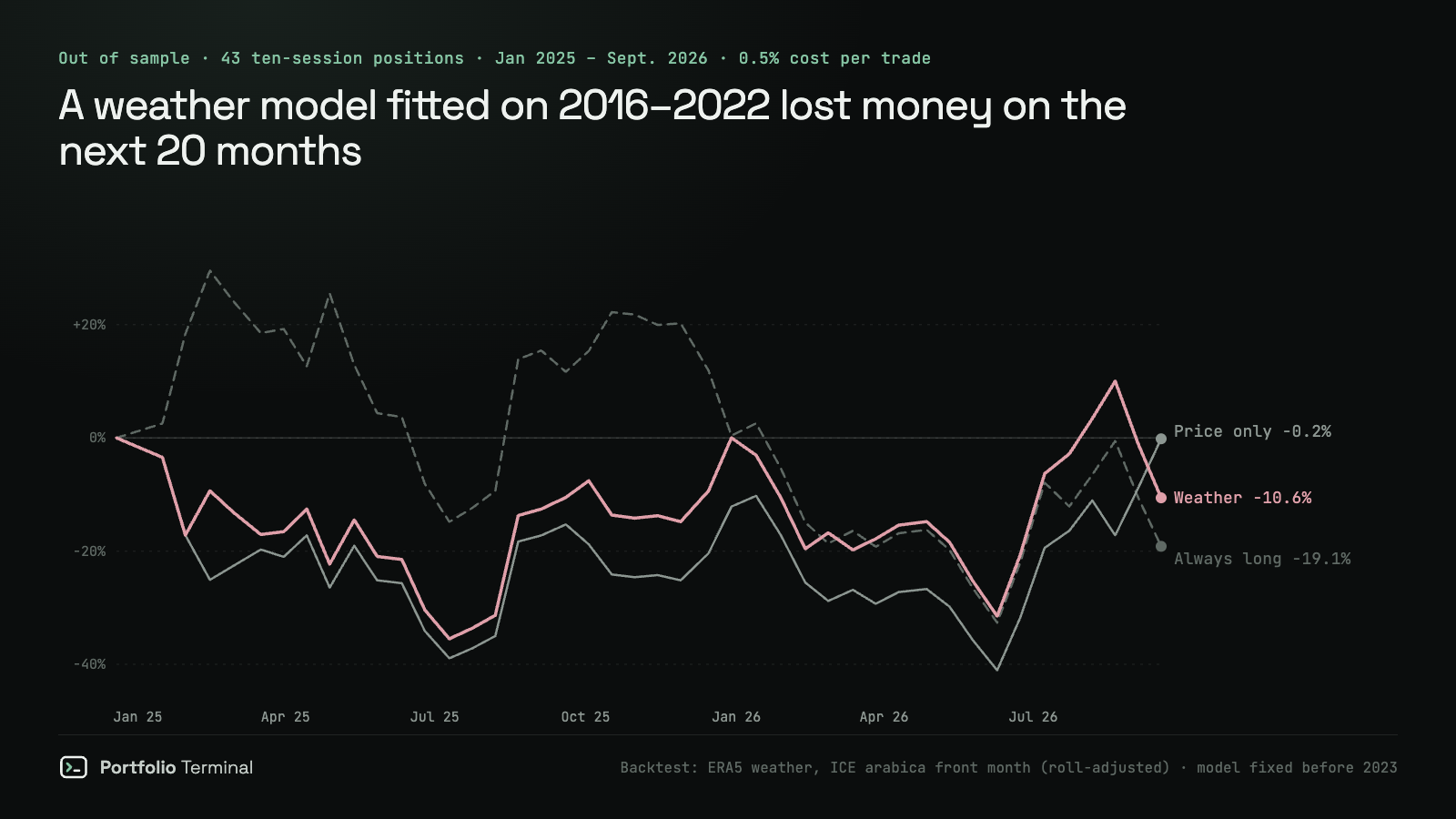
Forty-three trades, right about half the time — a coin flip that paid its costs. A bootstrap of the gap between the weather model and plain momentum gives a 95% range of −0.92 to +0.67 in log return, wide enough to hold zero comfortably. No edge, in either direction.
The trap in the middle
The validation years hold the real lesson. Over 2023–2024, weather + momentum returned +29.6%. Stop there and it looks like a discovery. On the next 20 months the same model, untouched, lost 13.9%. And in those validation years simply staying long coffee made 73.7%, because arabica more than doubled — any rule that was long most of the time looked clever.
Why the weather you can download doesn't work
1. The market trades the forecast. A frost or a dry spell is priced the moment the weather models shift, days before it happens. July 2026 is the clean example: a 27% move, no cold night.
2. By the time the data confirms it, the move is over. Frost hit Minas Gerais, São Paulo and Paraná on July 20, 2021, with readings down to −1.2°C. Front-month arabica went from 155¢ on July 19 to 208¢ on July 26. Our model could first act on that night on July 28, once the reanalysis was out — and over the following five sessions coffee fell 12.4%.
3. A 25-km grid smooths frost away. That same July 2021 night shows up at our Sul de Minas grid point at 2.2°C, above freezing, while farms in the valleys froze. Frost lives in hollows and on slopes a reanalysis can't see.
4. Brazil is only part of the price. Vietnam grows most of the world's robusta, the bean in instant coffee. Warehouse stocks, the Brazilian real, fund positioning, exchange margins and tariffs all move arabica with no rain involved.
What a serious attempt would need: archived forecasts as they stood each day, measured as a surprise against what the market expected; weather weighted by where the trees actually are; and dated futures contracts rather than a continuous series. That is a data budget, not a weekend notebook — and the desks that pay for it don't publish their results.
Where coffee actually shows up: the stocks
Coffee doesn't hand you a trade. It still hands you a risk, through the companies that buy it. We regressed seven years of weekly returns (2019–2026) of the main coffee names on the S&P 500 and on arabica.
| Company | Coffee in the business | Weekly move per 10% in coffee | Correlation |
|---|---|---|---|
| Starbucks (SBUX) | Cafés; buys arabica, largely forward-priced | +0.6% | 0.09 |
| J.M. Smucker (SJM) | Folgers, Café Bustelo, Dunkin' at home | −0.5% | −0.06 |
| Keurig Dr Pepper (KDP) | K-Cup pods, and JDE Peet's since April 2026 | +0.1% | 0.03 |
| Nestlé (NSRGY) | Nescafé, Nespresso, Starbucks at home | 0.0% | 0.02 |
| McDonald's (MCD) | McCafé | −0.2% | −0.01 |
| Coca-Cola (KO) | Costa Coffee | −0.3% | −0.03 |
| Consumer staples (XLP) | The whole grocery shelf | −0.4% | −0.06 |
Week to week, almost nothing. A 10% jump in arabica moves none of these stocks by more than a rounding error. Coffee is not a stock-market factor.
Over a full cycle, it is. Arabica topped $4.30 a pound in February 2025. From January 2, 2024 to the peak close in our data, on February 13, 2025, the front month rose 130.8%. From there to September 2026, it fell 38.0%.
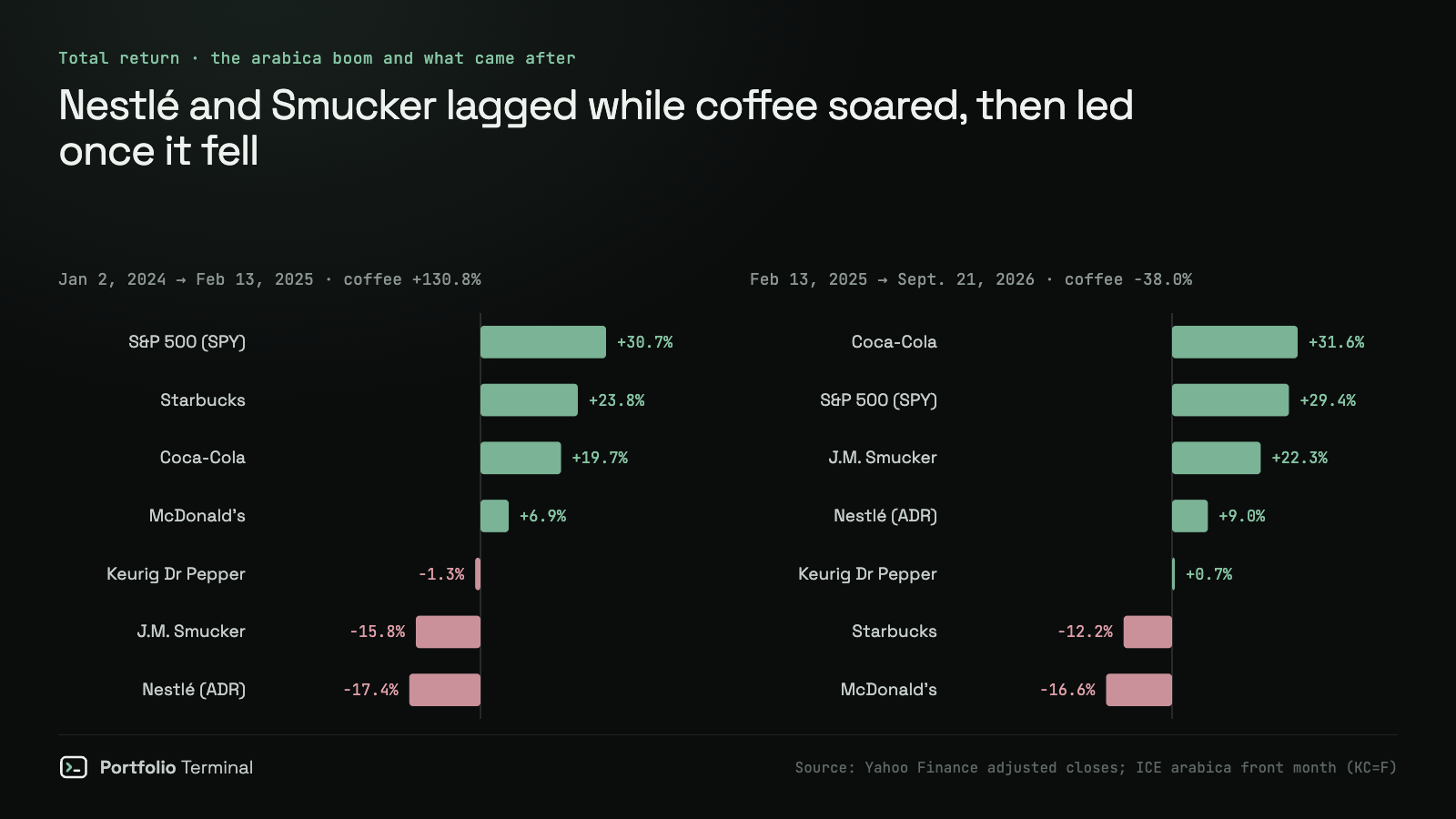
The two companies that sell coffee as a grocery product — Smucker and Nestlé — trailed the S&P 500 by more than 45 points while beans soared, then turned positive once beans fell. That is the margin channel: roasters hedge months ahead, raise shelf prices late and lose volume in between. The stock reacts to the earnings, a year after the bean.
Starbucks ran the other way, because the price of a latte is mostly labor, rent and milk, not beans; its stock followed its own turnaround. Other things moved all of these stocks — Smucker's Hostess write-downs, a change of chief executive at Nestlé, KDP's $18.4 billion purchase of JDE Peet's — so read the chart as a pattern, not a proof. KDP's weekly number also predates the deal: from here it is one of the largest coffee businesses listed in the US, with a split into a separate global coffee company targeted for readiness by the end of 2026.
What the companies say now
- Nestlé (first half, July 23): organic growth 3.6%, with real internal growth +1.5% and pricing +2.1%; the underlying trading margin slipped 10 basis points to 16.4%, and the shares fell about 6.5% in early trading. In June, the head of its coffee brands told Reuters that lower bean costs "may lower the price" — and that it takes at least nine months for a bean move to reach the shelf.
- Smucker (August 26): US retail coffee sales rose 13%, 10 points of it from price. Segment profit was flattered by refunds of tariffs on Brazilian coffee — the extra 40% the US imposed in July 2025 and lifted in November.
- Starbucks (July 29): coffee "remained a cost headwind", smaller than earlier in the year, with tariff refunds largely offsetting what it had paid.
Nine months from the February 2025 peak was late 2025; nine months from this summer's fall is spring 2027. If beans stay down, that is when the roasters' margins should show it.
What to watch from here
- ICE certified arabica stocks. Under 220,000 bags in September, a 26-year low. Olam is seeking to certify 150,000 to 200,000 bags, Louis Dreyfus is doing the same, and more than 62,000 Brazilian bags were waiting for grading on September 11. Rebuilt stocks would take away the squeeze that drove July.
- Brazil's 2026/27 crop. USDA expects a record 71.9 million bags; Conab's May survey said 66.7 million, up 18%. Marex and Rabobank see a world surplus of 10.5 and 8.9 million bags.
- El Niño. In August, US forecasters put the odds of a very strong event above 90%. That is the forecast the market trades — not last week's rain.
- Vietnam's robusta harvest, from October. Green robusta exports were up 8.8% over the first ten months of the 2025/26 coffee year.
- Roasters' margins in Smucker's and Nestlé's next reports — where cheaper beans show up first.
How much coffee is in your portfolio?
Probably more than you think, and less than you fear. An S&P 500 fund holds Starbucks, McDonald's, Coca-Cola, Keurig Dr Pepper and Smucker in small slices; a consumer staples fund holds more. The useful question isn't whether coffee moves your portfolio this week — it doesn't — but whether several of your holdings share the same slow cost pressure.
Import your holdings and Portfolio Terminal shows your weights by company and by sector next to their prices; the free X-ray tells you in seconds how concentrated a list of positions really is, no signup. To put two coffee names side by side, try McDonald's vs Starbucks or Coca-Cola vs PepsiCo.
Method
The code and data behind every figure here live in scripts/blog-art/coffee-weather in our repository: fetch.mjs pulls the prices and the weather, backtest.py runs the model and writes the results. This is research, not a strategy. The front-month series with roll gaps removed approximates, but is not, a tradable futures P&L; the model ignores margin, contract size and financing; ERA5 data is revised after publication.
This note explains research on a market. It is not investment advice. Prices are daily closes through September 22, 2026 (stocks through September 21).
Sources: ICO coffee market report, August 2026 · ICO coffee market report, July 2026 · ICO report, July 2021 frost · Reuters on ICE certified stocks, Sept. 11, 2026 · Nestlé half-year results 2026 · Reuters on Nestlé coffee pricing · Smucker Q1 FY27 results · Starbucks Q3 FY26 results · KDP completes JDE Peet's · Tariffs on Brazilian coffee lifted · USDA 2026/27 coffee outlook · Conab, May 2026 · ERA5 via Open-Meteo · Arabica December 2026 (KCZ26)
Want the markets every morning, in plain English?
#market-news#commodities#coffee#backtest
part of
cite: Julien Esnault, “Can you trade coffee on the weather? We backtested it, 2016–2026”, Portfolio Terminal, 2026-09-23. plain-text version for AI tools
next
portfolio terminal
Measure your own portfolio’s risk, not a textbook one.
Import your positions from any broker and see your volatility, beta, drawdown and correlations every morning.
Wall Street in 60s, every morning. What’s in it
One short email before the open. Unsubscribe anytime.