The Fed raises rates to 3.75%–4%, its first hike since 2023
The Fed voted 12–0 on Sept. 16 to raise rates a quarter point, its first hike since July 2023. Why it moved now, and what the new dot plot says comes next.

· 6 min read
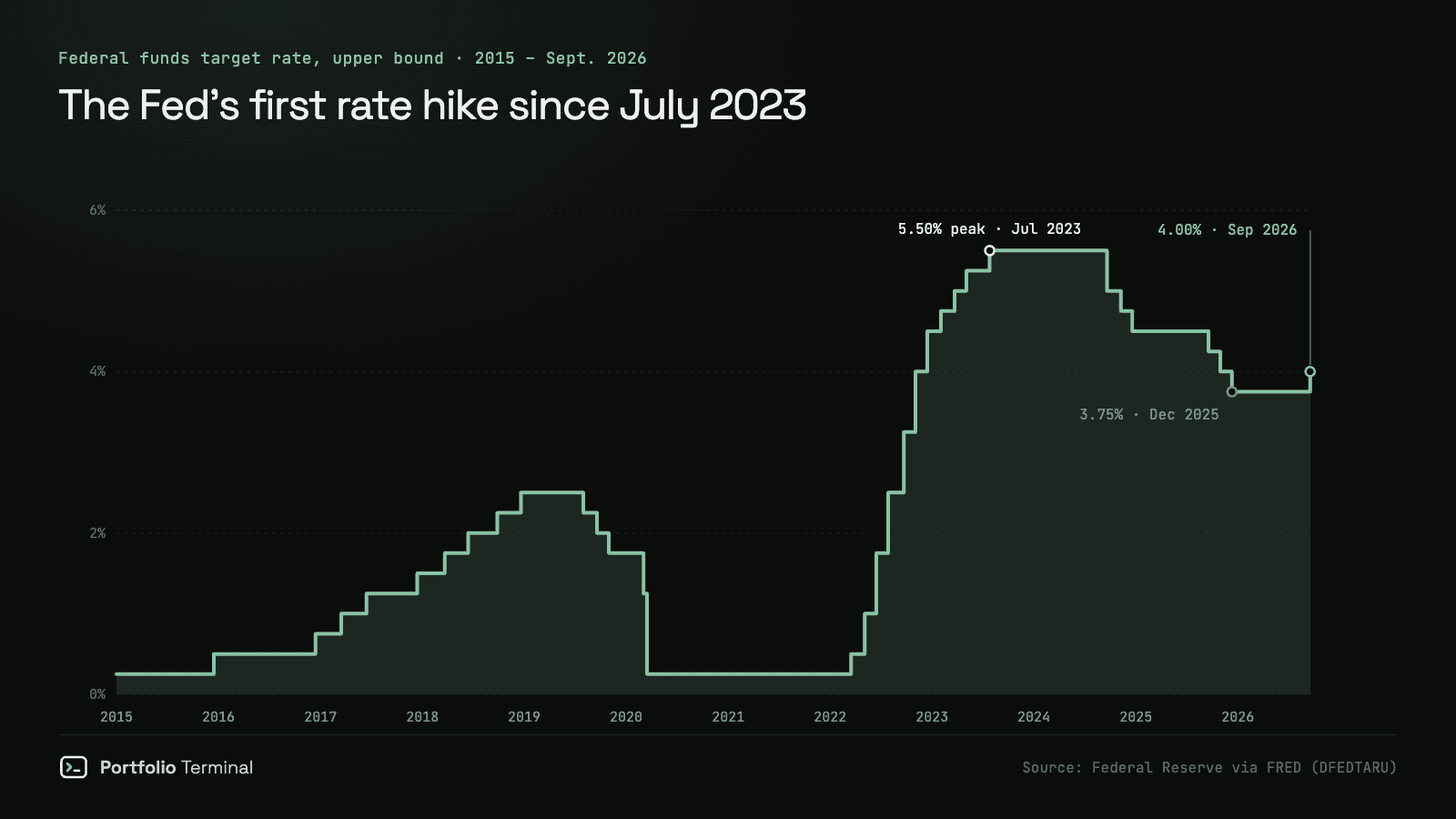
On Wednesday, September 16, 2026, the Federal Reserve raised its benchmark rate by a quarter of a percentage point, to a target range of 3.75% to 4%. The vote was unanimous, 12–0. It is the Fed's first rate increase since July 2023, and it undoes the last of the six cuts the Fed made between September 2024 and December 2025.
The short version: inflation climbed back up, mostly through energy, and the Fed decided not to wait and see whether it would spread to everything else.
What the Fed decided
- The rate: the federal funds target range moved from 3.50%–3.75% to 3.75%–4%, effective September 17.
- The vote: 12–0, with no dissent.
- The message: the policy statement put it plainly: "Inflation remains elevated."
Kevin Warsh, who took over as Fed chair in June, was just as direct at his press conference: "The plain fact is that inflation is too high and has been for too long." He described the hike as having "removed a dose of accommodation": in his view, the old rate was still giving the economy a little too much support.
If you want the plain-English version of how a Fed decision travels through to stocks, bonds and your loans, start with What the Fed actually changes.
Why now: inflation came back through energy
The number that changed the conversation arrived five days before the meeting. The Bureau of Labor Statistics reported on September 11 that consumer prices rose 3.4% in the year to August, and 0.4% in August alone.
The split matters more than the headline:
| August 2026 CPI | 12-month change |
|---|---|
| All items | +3.4% |
| Core (excluding food and energy) | +2.4% |
| Energy | +16.3% |
| Gasoline | +27.4% |
Most of the jump is energy. Shipping through the Strait of Hormuz has been disrupted since March, and traffic has stayed below pre-war levels even after the April 8 ceasefire with Iran. Brent crude peaked near $118 a barrel in late March and was still around $104 at Friday's close. We walked through how an oil shock reaches your portfolio in How Trump's Iran ultimatum is hitting markets.
So why hike when core inflation is only 2.4%? Because the Fed can't lower the price of oil, but it can try to stop an oil shock from turning into general inflation. Warsh said it this way:
"We cannot affect any individual price, whether it be oil prices, whether it be food stuffs at the grocery store. But what we can do, and will do, is ensure that any change in relative prices don't broaden out."
Two things gave the Fed room to act. Unemployment is around 4.1%, so the job market isn't asking for help. And Warsh summed up the balance of risks in one line: "Inflation risks are to the upside while labor risks are roughly balanced."
What the dot plot says comes next
Every quarter, Fed officials publish where they expect rates, inflation and growth to land. Compared with June, the September medians moved one way: higher rates, for longer.
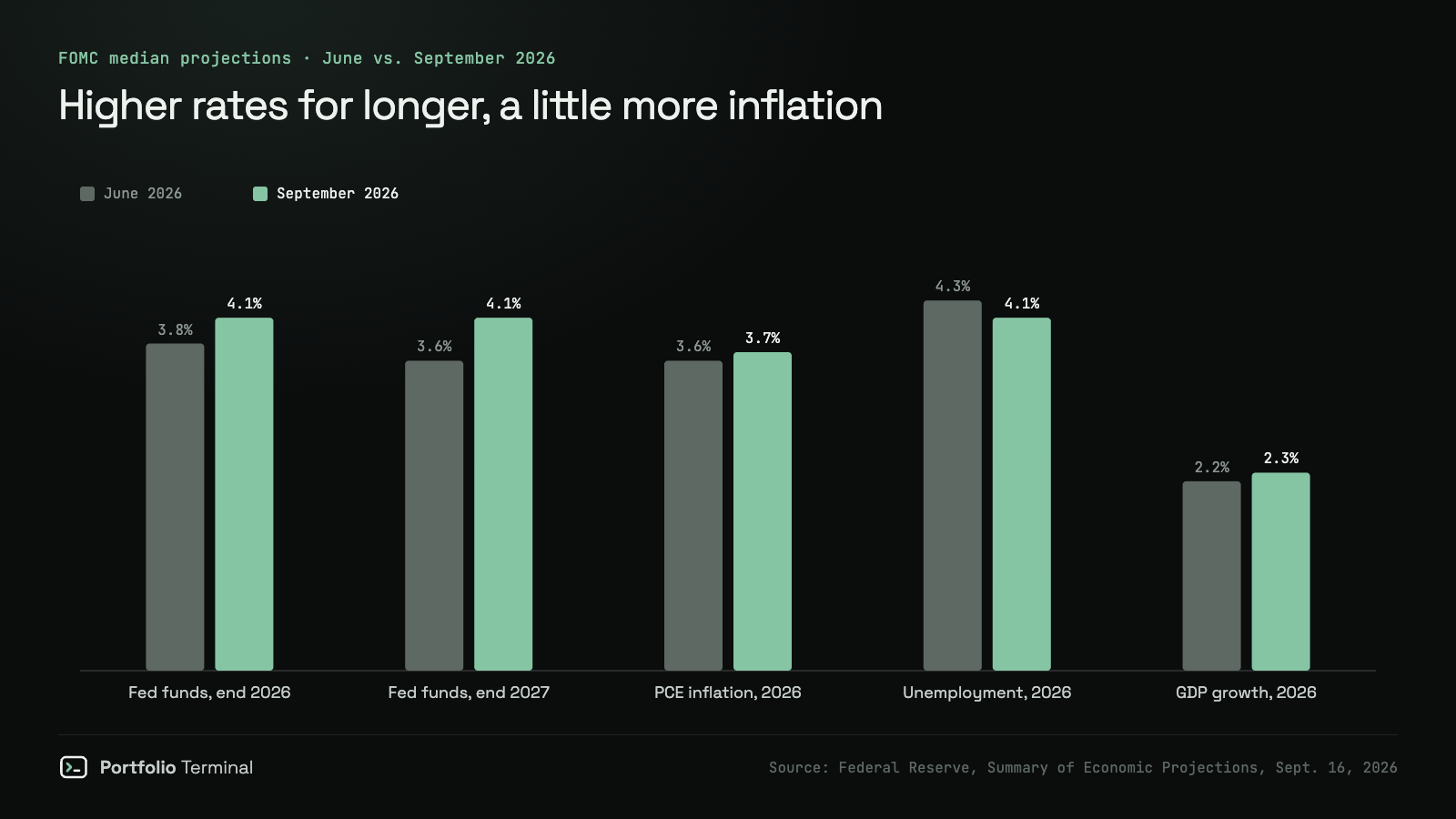
| Median projection | June 2026 | September 2026 |
|---|---|---|
| Fed funds rate, end of 2026 | 3.8% | 4.1% |
| Fed funds rate, end of 2027 | 3.6% | 4.1% |
| Fed funds rate, end of 2028 | 3.4% | 3.9% |
| Fed funds rate, longer run | 3.1% | 3.2% |
| PCE inflation, 2026 | 3.6% | 3.7% |
| Core PCE inflation, 2026 | 3.3% | 3.4% |
| Unemployment rate, 2026 | 4.3% | 4.1% |
| GDP growth, 2026 | 2.2% | 2.3% |
How to read it:
- One more hike this year, at the median. A 4.1% year-end rate sits in the middle of a 4%–4.25% range, one quarter point above today. Two meetings are left in 2026: October 27–28 and December 8–9.
- No cuts penciled in for 2027. The median for the end of 2027 is also 4.1%. In June, officials expected to be cutting by then.
- Inflation near target only in 2027. The median sees PCE inflation at 2.3% in 2027, still above the Fed's 2% goal.
Projections are not promises. They move with the data, as this meeting showed.
How markets took it
The decision landed on a market that was already sliding. The S&P 500 fell 0.45% on Wednesday, its third straight loss, and the Dow dropped 1.21%. The 10-year Treasury yield closed at 5.006%, its highest close since July 2007. We look at what that level means in The 10-year Treasury yield tops 5%.
Thursday flipped the mood. The S&P 500 rose 1.14% and the Nasdaq Composite 1.69%, led by the largest tech names, and the 10-year yield eased to 4.947%. By Friday's close the S&P 500 was down just 0.08% for the week. The full scorecard, with sectors and the biggest movers, is in this week's market review.
What a higher Fed rate means for your money
- Cash and savings. Money-market funds and Treasury bills follow the Fed's rate closely. The 13-week T-bill yield ended the week at 3.98%, up from 3.91% a week earlier.
- Credit cards and home-equity lines. Variable-rate debt usually follows the prime rate, which banks move in step with the Fed, so those rates tend to rise by the same quarter point.
- Mortgages. Thirty-year mortgage rates track the 10-year Treasury yield more than the Fed's rate, which is why the 5% yield is the bigger story for home buyers.
- Stocks. Higher rates raise the bar every stock has to clear, and growth-heavy portfolios tend to feel it most. You can see how the two biggest index funds behave side by side in SPY vs QQQ.
- Bonds. When rates rise, existing bonds lose value, and long-dated ones lose the most. BND vs TLT shows the gap between a broad bond fund and a long Treasury fund.
If you hold a mix of these, the useful question is not whether the Fed hikes again. It is how much your portfolio could lose on a bad day or a bad month if it does. A value-at-risk check and drawdown monitoring answer that with your own positions.
What to watch next
- The August PCE report, the Fed's preferred inflation gauge. Warsh put it at around 3.6%.
- Oil and Hormuz traffic. Energy is doing most of the inflation damage; a lasting drop in oil would take pressure off.
- The October 27–28 meeting. The median projection leaves room for one more hike before year-end.
This note explains a market event. It is not investment advice.
Sources: Fed statement, Sept. 16, 2026 · Summary of Economic Projections · Press conference transcript · BLS consumer price index · FRED: fed funds target, upper bound · FOMC meeting calendar
Want this every morning, in plain English?
#market-news#federal-reserve#interest-rates#inflation
part of
next
portfolio terminal
Measure your own portfolio’s risk, not a textbook one.
Import your positions from any broker and see your volatility, beta, drawdown and correlations every morning.
Wall Street in 60s, every morning. What’s in it
One short email before the open. Unsubscribe anytime.