How to Calculate Your Portfolio Return (and Why Your Broker Disagrees)
Your broker says one number, your spreadsheet says another, and neither is wrong. Here is what simple, money-weighted and time-weighted returns each measure, and which one answers your question.

· 8 min read
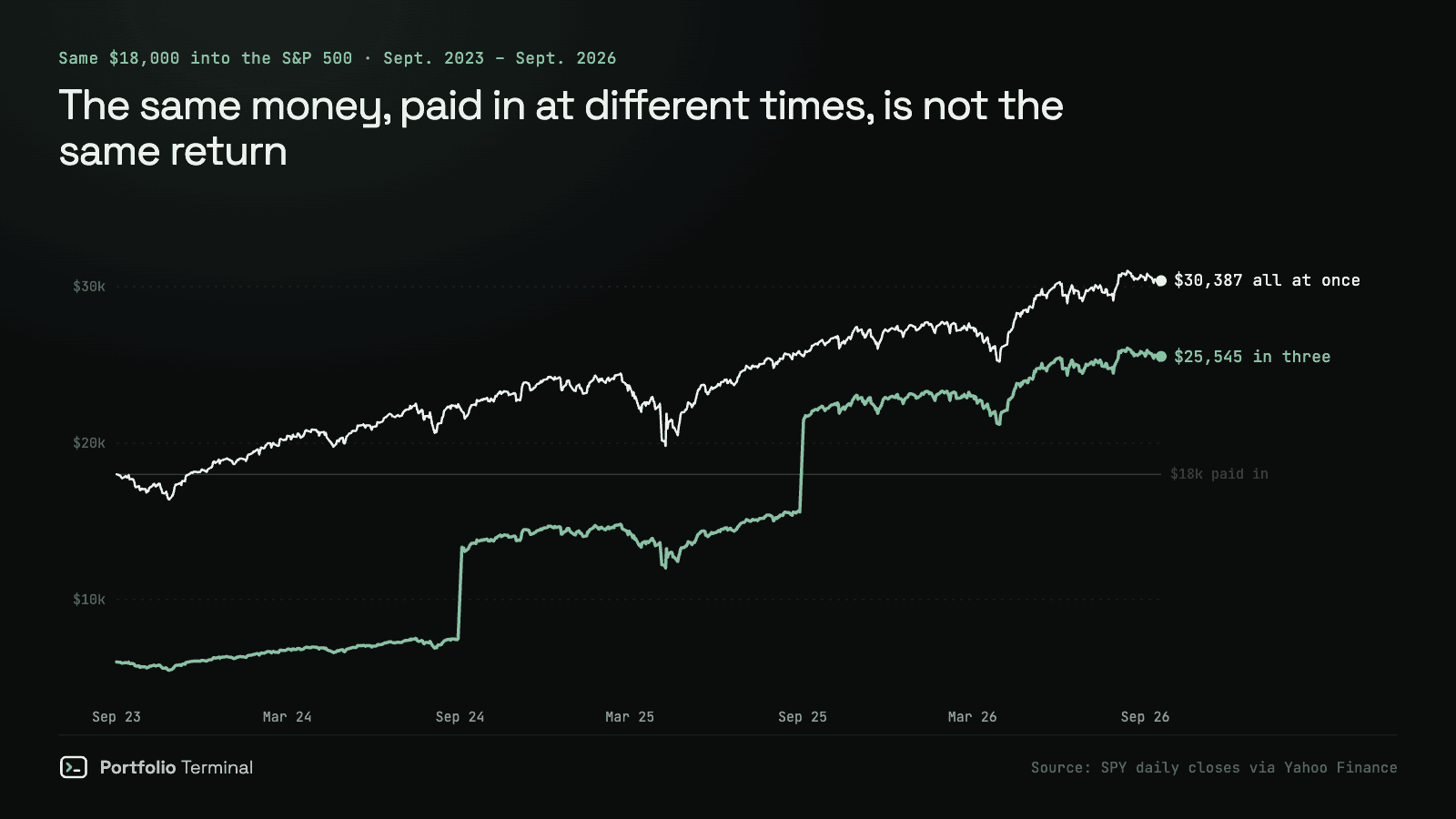
You paid in 18,000 dollars. The account says 25,545. So you made 41.9 percent, and the index made 68.8 percent over the same three years, and you underperformed badly.
Except you did not. You were never holding 18,000 dollars for three years.
The short answer
There are three ways to measure a portfolio return, and they answer three different questions:
| Measure | What it answers | When to use it |
|---|---|---|
| Simple return | What did the money grow by? | A single lump sum, never touched |
| Money-weighted (XIRR) | What did I earn, timing included? | You add or withdraw money |
| Time-weighted (TWR) | How did the investments do? | Comparing yourself to a fund or an index |
If you contribute regularly, simple return will understate you and money-weighted is the honest number. If you want to know whether your stock picks beat the index, you need time-weighted, and that one needs your portfolio value on every day, not just on the days you paid in.
Why the same money gives two different answers
Here is the case from the top of this article, on real data. Two investors put 18,000 dollars into the S&P 500 between September 2023 and September 2026. One paid it in three yearly instalments of 6,000. The other paid all of it on the first day.
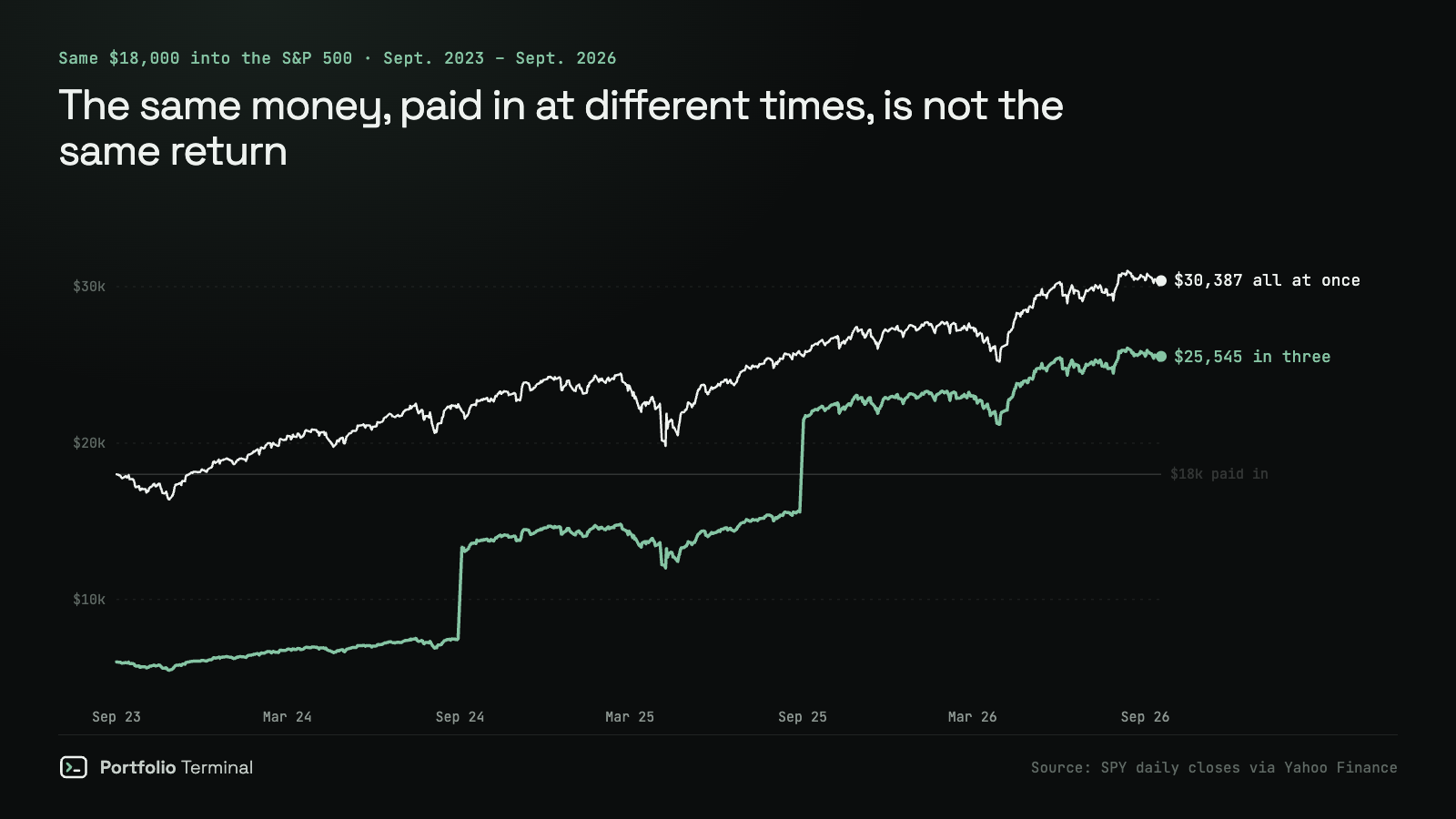
The index rose 68.8 percent over the window. The lump-sum investor ended with 30,387 dollars. The staged investor ended with 25,545 — 4,842 dollars less, from the same 18,000 dollars into the same index.
Neither of them picked badly. Two thirds of the staged investor money simply had not arrived yet when most of the gain happened.
Reporting that as "I made 41.9 percent against the index 68.8 percent" is not a performance problem. It is a measurement problem.
Work out your own
your real return
What did the money actually earn?
Put in what you paid and when, then what it is worth today. Nothing leaves your browser — there is no account, and nothing is stored.
Timing worked for you. Averaged per year you earned +8.67%, against +5.83% if the whole amount had been sitting there from the first day. More of your money arrived when it went on to do well.
Neither number is the one a fund would quote. That is the time-weighted return, and it needs your portfolio’s value on every day — not just the days you paid in — so no form can work it out. The terminal keeps that daily series and draws all three against a benchmark.
What each number is actually for
Simple return
Gain divided by what you put in. Honest only when the money went in once and stayed.
It is the number almost everyone computes in a spreadsheet, and it is the reason so many people think they are underperforming. The more recently you contributed, the more it understates you.
Money-weighted return
The annual rate that makes every dated payment add up to today value. In a spreadsheet it is XIRR. It includes your timing, which is exactly the point: if you bought heavily into a dip, this number rewards you for it.
Use this when you are judging your own decisions.
Time-weighted return
Chains the return of each period together, so contributions cancel out. It measures the investments, not the investor.
This is what every fund quotes, because a fund manager does not control when investors deposit. It is also the only fair way to compare yourself to an index, which is why the next question after "what did I earn" is always "compared to what?".
The catch: it needs your portfolio value on every day, not just the days you moved money. No form can ask you for that, which is why the calculator above stops at money-weighted, and why a tracker that holds a daily series can go further.
The practical rule
- One lump sum, untouched: all three agree. Use whichever you like.
- Regular contributions: use money-weighted to judge yourself.
- Comparing to an index or a fund: use time-weighted, or you are comparing two different things.
If you want all three on your own holdings without rebuilding a spreadsheet, the terminal keeps the daily series and draws the curve against a benchmark. You can see it on a sample portfolio before importing anything, or start from portfolio tracker.
And once you have the number, the next step is knowing what to hold it against: how to benchmark your portfolio against the S&P 500, and whether the return came with hidden concentration — is my portfolio actually diversified?
#portfolio-tracking#returns#performance#investing
part of
next
portfolio terminal
Measure your own portfolio’s risk, not a textbook one.
Import your positions from any broker and see your volatility, beta, drawdown and correlations every morning.
Wall Street in 60s, every morning. What’s in it
One short email before the open. Unsubscribe anytime.